CORE: Canonical Object Representations for Enhanced Manipulation

AdapComp Lab, National University of Singapore  Â·  Xi'an Jiaotong University
Advised by Dr. Hanbo Zhang and Prof. David Hsu
EEML 2025 Best Poster Award

Closed-loop rollout of the object-centric policy on the door-opening task in RLBench (CoppeliaSim), with front, wrist and overhead camera streams shown on the right.

Abstract

We introduce a novel approach for manipulating articulated objects with the ability to generalize across object translations, scaling, and robot kinematics. In traditional imitation learning, the learned policy fails if camera perspectives or the relative positions of objects change during inference, and it is specific to certain robot configurations. To tackle these challenges, we propose an object-centric representation for both observations of object motions and robot actions, which decouples vision-based decision making from robot execution. The center here refers to a canonical frame of the articulated object that remains invariant regardless of the contact point. We further use object-centric imitation learning to make stable predictions under varying camera views, object placements, and robot kinematics. Experiments and analysis demonstrate that our method achieves state-of-the-art performance in articulated object manipulation and dramatically improves generalization.
Why decouple vision and motion?

Pixel-based policies with trajectories anchored in the robot's base frame overfit to the exact camera pose and object placement seen during training. CORE instead reasons in a frame attached to the object itself, so the same policy transfers when the camera moves or the door is placed somewhere new.

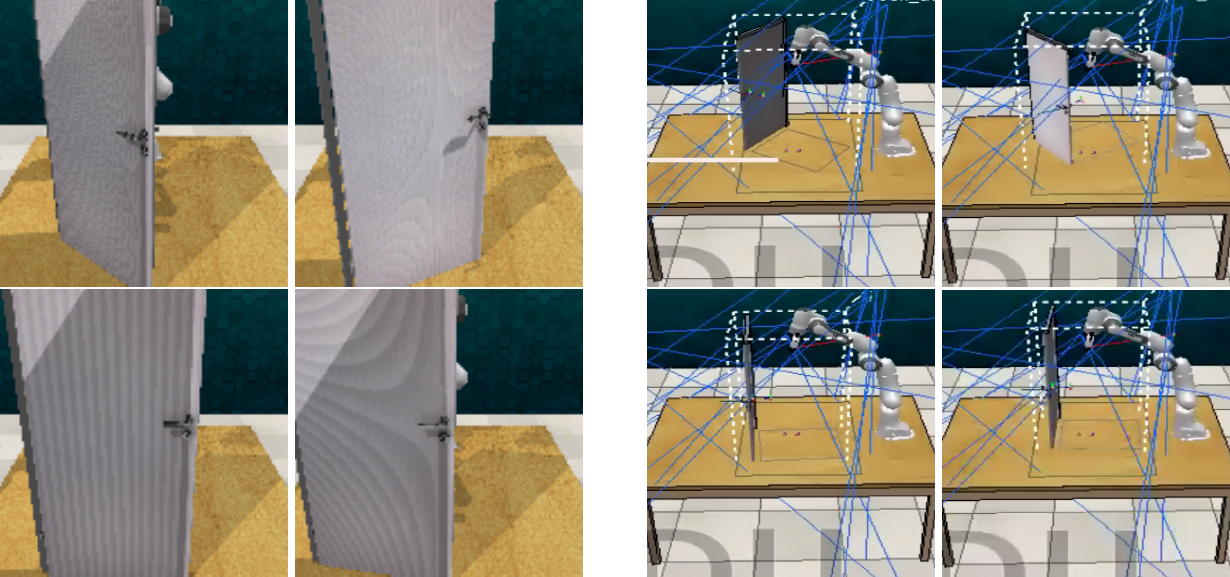
Four camera viewpoints of a door (left) and four door placements relative to a Panda arm (right)
Generalization targets. Left: the same door seen from different camera viewpoints. Right: the same door under different placements. An object-centric policy produces consistent actions across all of these conditions.

Method

A contact-anchored object frame turns observations and actions into a representation that is invariant to where the object is, where the camera is, and which robot executes the motion.

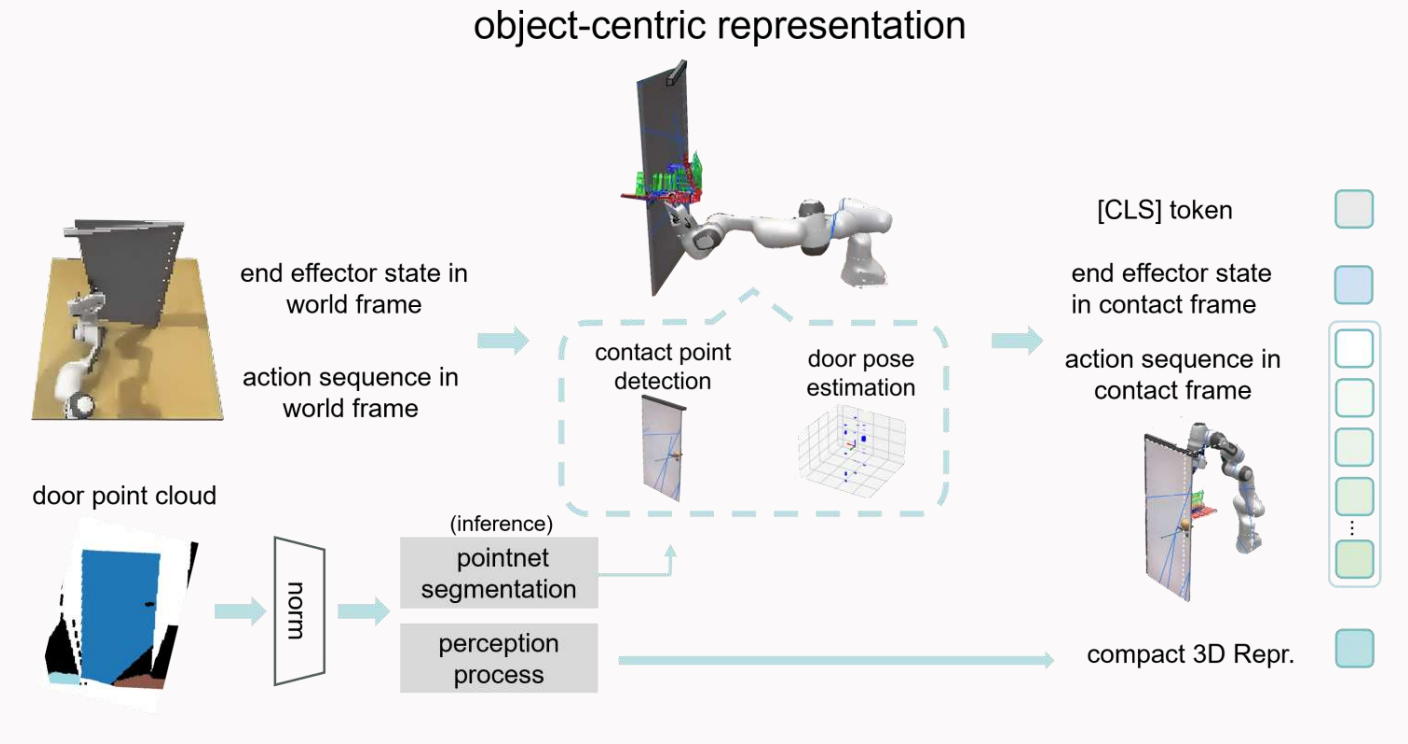
Overview of the CORE object-centric policy
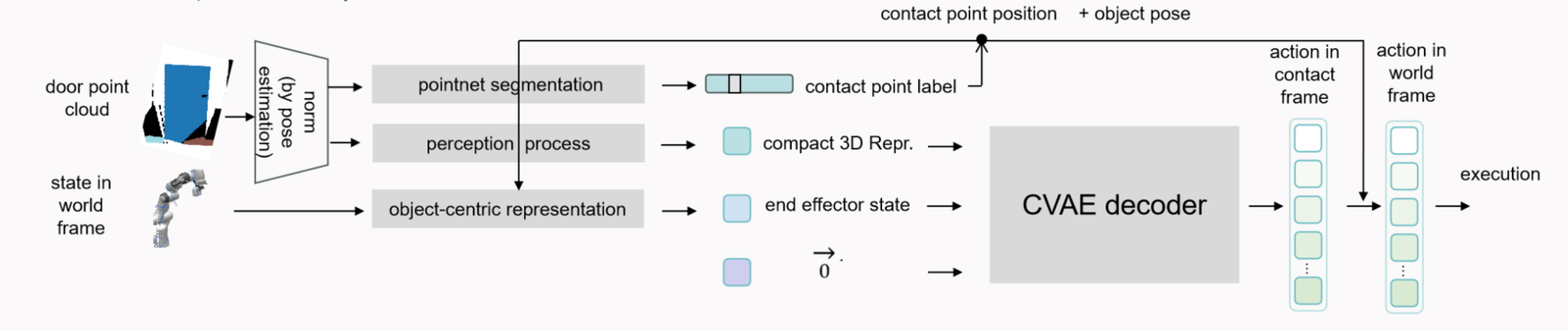
Overview. End-effector states and action sequences are transformed from the world frame into a contact frame, established by contact-point detection and door-pose estimation. A PointNet segmentation model and a lightweight perception encoder turn the normalized door point cloud into a contact label and a compact 3D representation.
1

Canonical object frame

The frame is anchored at the contact point p* on the door. Its Z-axis follows the hinge, X is normal to the door surface, and Y = Z × X. Point clouds are rotated into this frame and centered at their centroid, and actions are expressed relative to p*.

2

Contact-aware perception

A PointNet segmentation network predicts per-point contact confidence on the cropped, unit-normalized door cloud (1,024 points). Door orientation comes from an oriented bounding box, and a DP3-style MLP encoder compresses the cloud into a 64-d feature.

3

Object-centric CVAE policy

An ACT-style CVAE predicts chunks of end-effector poses and gripper widths in the object frame, conditioned on the 3D feature and the object-centric robot state. Predicted actions are mapped back to the robot's base frame for execution.

Object-centric transforms

Given the estimated object rotation R and contact point p*, observations and actions are mapped into the object frame At:

P′t = R · (Pt − p̄t) + t p̂t:t+k = R · (pt:t+k − p*) + t R̂t:t+k = R · Rt:t+k

At inference the predicted chunk is transformed back with p = Rᵀ · p̂ + p* and R = Rᵀ · R̂, so the robot's own kinematics never enter the learned policy.

Policy architecture and inference

Inference pipeline from door point cloud to executed action
Inference. The predicted contact point and estimated door pose build the object-centric input and also carry the predicted actions back to the world frame for execution.
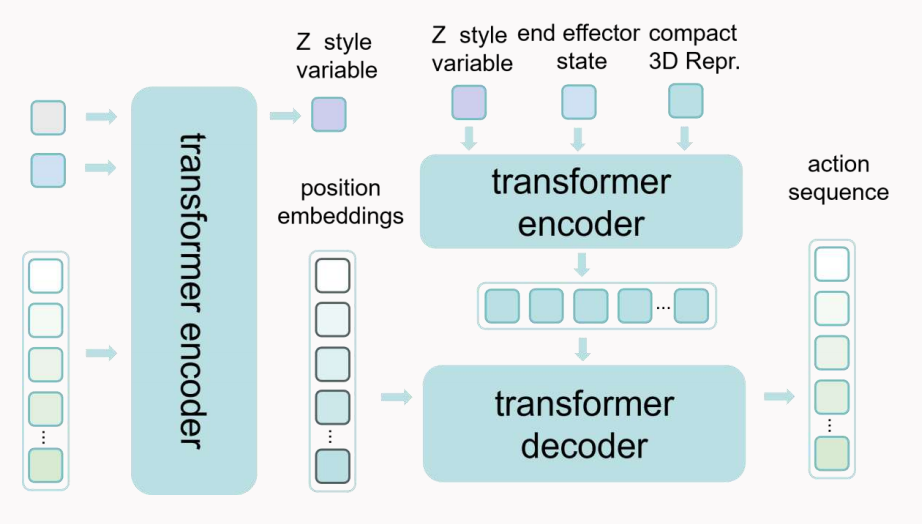
CVAE policy architecture with transformer encoder and decoder
CVAE policy. The encoder infers a style variable z from the action chunk (training only); the decoder conditions on z, the end-effector state and the compact 3D representation to output an action sequence.

Experiments

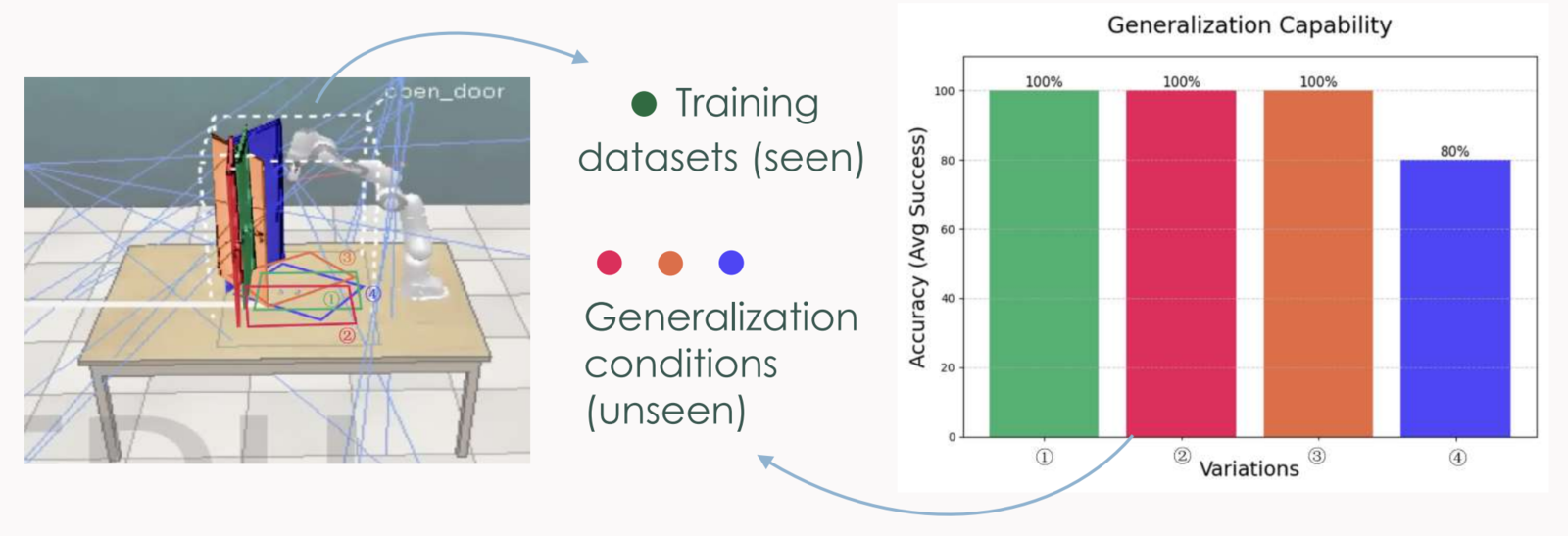
40 expert demonstrations of door opening with a simulated Panda arm in RLBench. Training uses only placement ①; placements ②–④ and their camera views are out of distribution. Each setting is evaluated over 40 episodes × 3 seeds. Success means the door opens at least 25°.

Door placements used for training and testing, with per-variation success rates
Training placement (green) and unseen test placements (red, orange, blue). CORE reaches 100% success on ①–③ and 80% on ④.

Spatial generalization

MethodInput①②③④Avg. success (%)
ACTRGB-D✓✗✗✗30.0
DP3Scene point cloud✓✗✗✗15.0
CORE (ours)Object point cloud✓✓✓✓95.0
95%
average success across placements
3.2×
higher than the strongest baseline (ACT)
9.68
FPS closed-loop inference
1,024
object points used (of ~10k scene points)

Input modalities

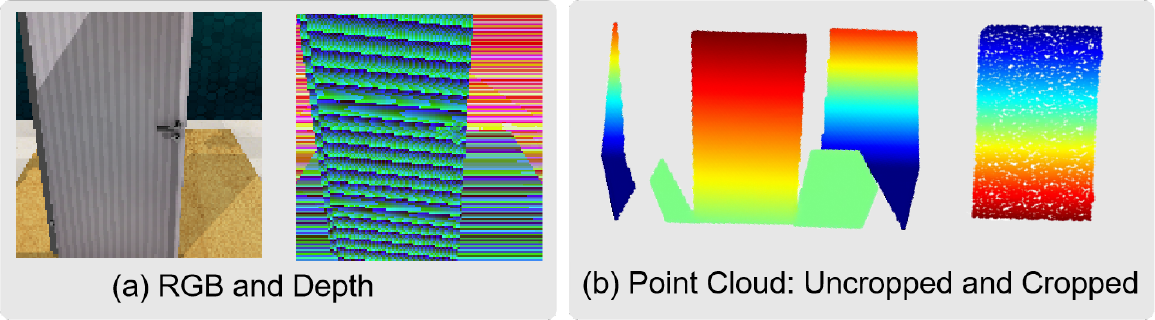
RGB and depth images, uncropped and cropped point clouds
ACT consumes RGB-D images, DP3 consumes the uncropped scene point cloud, and CORE uses only the cropped point cloud of the door.

Qualitative results

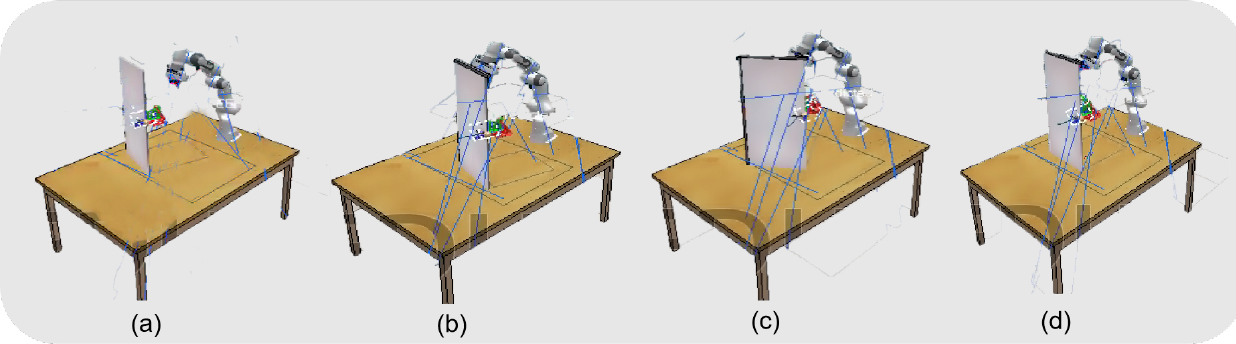
Predicted trajectories and contact points under four placements
Predicted contact location and end-effector trajectory overlaid on the scene for four object displacements and camera viewpoints.
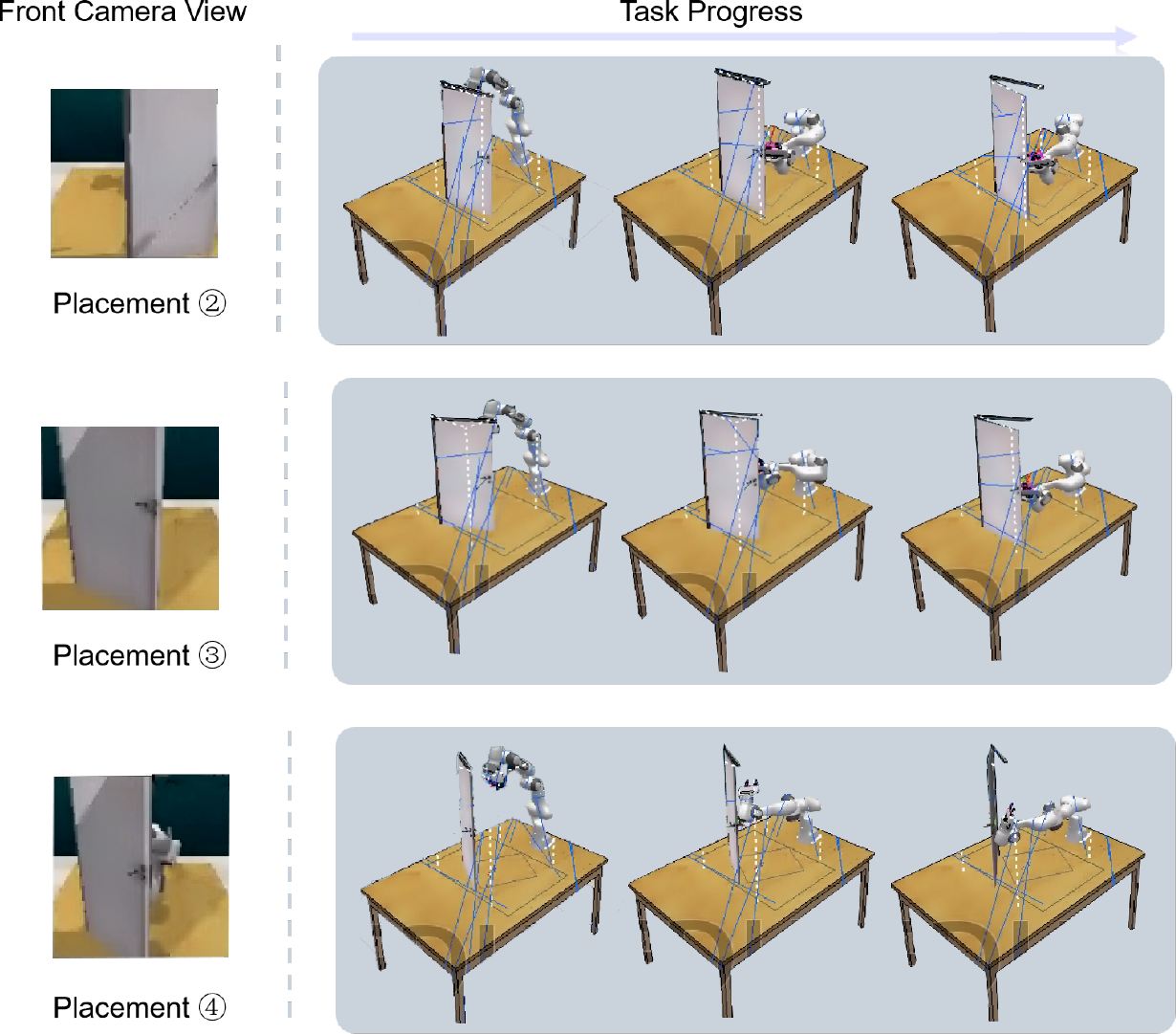
Task progress at unseen placements 2, 3 and 4
Task progress at unseen placements ②–④ (10 trials each), with the front-camera view on the left.
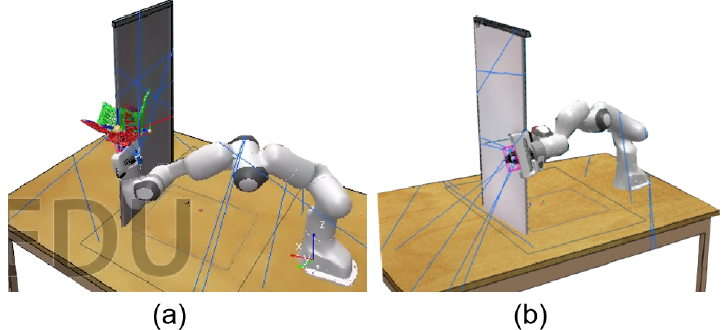
Successful handle manipulation by CORE versus failure by baselines
(a) CORE keeps its predicted trajectory aligned with the door and handle at unseen positions. (b) Baselines typically fail because the gripper never reaches the handle.

Limitations

The remaining failures at placement â‘£ happen when the elbow collides with the door on the approach. The door still opens, but without proper use of the handle. An object-centric trajectory transfers across placements, but it still has to fall within the robot's reachable workspace. Otherwise planning can fail or the view can become occluded.

Citation

@thesis{xu2025core,
  title  = {CORE: Canonical Object Representations for Enhanced Manipulation},
  author = {Tongmiao Xu},
  type   = {Bachelor's thesis},
  school = {Xi'an Jiaotong University},
  note   = {Research conducted at the AdapComp Lab, National University of Singapore},
  year   = {2025}
}